10 Areas Every Advisor Should Assess Before Recommending a Plan
 Succession Planning Resource
Succession planning areas advisors should assess before making recommendations, using the Succession Matrix® to spot gaps.

The succession planning areas advisors should assess usually extend beyond the business owner’s initial request. Before recommending a plan, advisors need to understand what the owner wants, how the business operates, who is ready to lead, and how the family system may affect the outcome.
Quick Summary
Succession planning areas advisors should assess include owner motivation, personal financial planning, business structure, performance, strategy, leadership, teamwork, successor readiness, family dynamics, and family governance. Among succession planning models, the Succession Matrix® helps advisors see how these areas connect before recommending a specific plan.
Why Advisors Should Assess Before They Recommend
Business owners often come to an advisor with one clear request. They might ask for an estate plan, a buy-sell agreement, a valuation, or guidance on retirement timing. Those requests matter, but they rarely tell the whole story.
A complete succession planning conversation looks beyond the ownership transfer or exit event. It also includes leadership continuity, governance, successor readiness, family alignment, and business continuity. That broader context helps advisors understand why one planning issue often connects to several others.
The succession planning areas advisors should assess help uncover the interconnected issues behind that first request. When an advisor moves too quickly to a solution, the recommendation might solve the first request while missing the issue that puts the plan at risk.
A strong estate plan often struggles if the successor lacks preparation. A sale strategy loses value when the business depends too heavily on the current owner. A leadership plan stalls when the family carries unresolved conflict.
For advisors, this creates a meaningful opportunity. You can respect your area of expertise while still recognizing when a client needs a broader planning conversation. The Succession Matrix® helps advisors see the full planning picture.
Succession Planning Areas Advisors Should Assess First
The Succession Matrix® organizes business succession into 10 interconnected areas. The International Succession Planning Association® (ISPA®) developed the Succession Matrix® to help advisors evaluate the personal, business, management, and family factors that influence succession planning outcomes. A gap in one area often changes what is possible in another. These areas help advisors slow the conversation down, ask better questions, and understand what affects the plan before moving into recommendations.
For example, an owner may ask for help with an ownership transfer, but the real issue might be that the successor has never led the management team through a major decision. In that case, the next step involves leadership preparation before ownership documents can do their job.
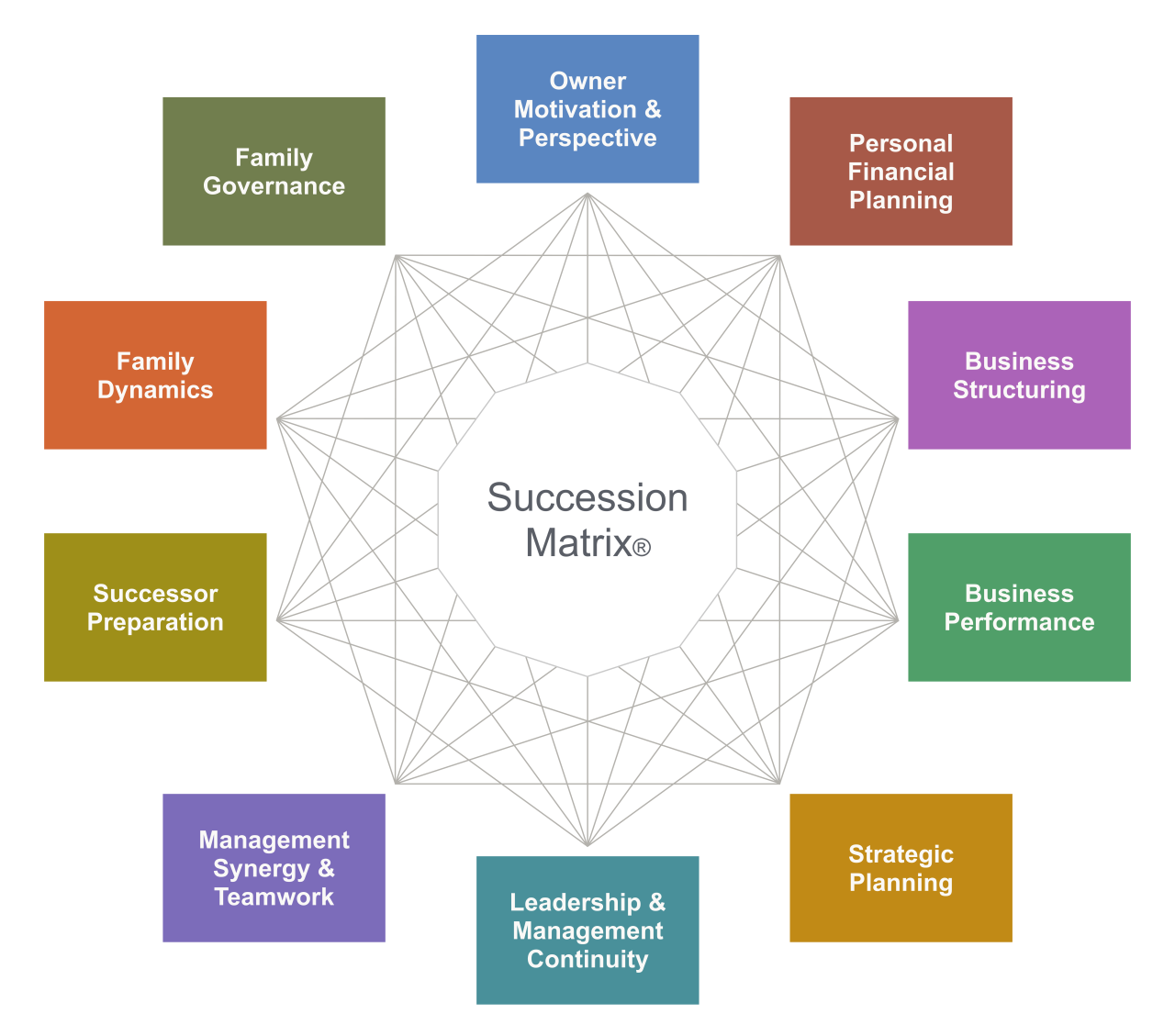
1. Owner Motivation and Perspective
Owner motivation shapes the entire planning process. Start by understanding what the owner wants the business to accomplish.
Does the owner want to keep the business in the family? Sell to a third party? Transition to key managers? Create retirement income? Protect employees? Preserve a family legacy?
When the owner lacks clarity, the plan usually lacks clarity too.
2. Personal Financial Planning
A succession plan depends on the owner’s personal financial readiness. If the owner still relies on the business for income, benefits, or lifestyle support, they often struggle to step away.
Look at retirement income, liquidity, estate planning, risk tolerance, and credit obligations. An owner who feels financially unprepared often delays leadership transfer, ownership transfer, or exit planning, which creates pressure for successors and uncertainty for the business.
3. Business Structuring
Business structure determines how ownership, control, agreements, and documentation support the transition. Review outdated documents, unclear ownership rights, missing buy-sell terms, or structures that no longer match the owner’s goals.
This area often involves attorneys, CPAs, and other technical advisors. A succession-minded advisor helps identify when the current structure creates friction for the desired outcome.
4. Business Performance
Business performance affects value, confidence, and transition options. Before recommending a succession plan, consider whether the business continues to perform without the current owner carrying most of the weight.
Key questions include: Is the business profitable? Is cash flow stable? Are margins healthy? Does the business depend too much on one person, one customer, or one vendor?
A business with weak performance often needs operational attention before ownership transfer or exit planning becomes realistic.
5. Strategic Planning
Strategic planning gives the business direction beyond the current owner. Look for a clear mission, growth vision, and accountability process.
A strong succession plan answers two questions: “Who will continue the business?” and “Where is the business going?”
Without strategy, successors inherit confusion, key managers lose confidence, and family members disagree about the future.
6. Leadership and Management Continuity
Leadership continuity asks whether the business operates when the owner steps away from daily decisions. Consider who currently leads, who could lead next, and what would happen if the owner were suddenly unavailable.
This area also helps advisors compare the role of a succession planner, exit planner, and family business advisor. Exit planning may focus on leaving the business. Succession planning looks at whether success continues after the transition.
7. Management Synergy and Teamwork
Even a strong successor needs a strong team. Look at whether the management team works well together, communicates clearly, and trusts one another.
A leadership transition often reveals tension that has been easy to overlook. Key managers might compete for influence. Long-time employees might resist change. Family members might question decisions. When the team lacks trust, the plan loses momentum.
8. Successor Preparation
Successor preparation involves developing the person or people who will own, lead, or manage the business in the future.
Review whether successors have the training, experience, confidence, and accountability they need. A successor might be capable but underprepared. Another might be willing but lack support from employees, family members, or key managers.
9. Family Dynamics
Family dynamics quietly influence every technical plan. Pay attention to communication patterns, trust levels, past conflict, fairness concerns, and the role of spouses, siblings, in-laws, and inactive family members.
A family might agree in public while carrying private concerns. One child might feel overlooked. A non-active family member might expect ownership benefits without responsibility. A successor might feel pressure to prove they belong.
10. Family Governance
Family governance creates structure for how the family communicates, makes decisions, and stays aligned around the business. Review expectations for employment, ownership, leadership, compensation, conflict resolution, and family involvement.
Clear expectations help protect the business and the relationships around it, especially when ownership will be shared across active and inactive family members.
As you review these areas, the goal is to notice where a client needs more discovery before a recommendation is made. The advisor’s role is to recognize what deserves more attention, then bring in the right people when deeper support is needed.
How One Weak Area Can Affect the Whole Plan
The succession planning areas advisors should assess are interconnected, and a weakness in one area creates pressure in another.
For example, when the owner lacks financial independence, they often delay their exit. That delay limits the successor’s leadership experience. When the successor lacks experience, key managers lose confidence. When managers lose confidence, business performance suffers. As performance declines, family tension grows.
This is why isolated recommendations create risk. A client may need a legal document, valuation, or sale plan, but those tools work best when the advisor uses a broader planning framework to understand the larger readiness picture.
Turn Assessment into a Better Planning Conversation
The succession planning areas advisors should assess give clients a clearer way to understand where they are today and what deserves attention next. Start with the client’s first concern. Then look for the connected issue behind it. Finally, decide whether the next step is technical planning, leadership development, family alignment, governance, or deeper discovery.
A succession planning assessment makes this easier. The Succession Planning Assessment™ helps turn broad concerns into a structured readiness conversation. Advisors who want a practical starting point can use better discovery questions to uncover the issues that shape the next recommendation.
Key Takeaways
- The succession planning areas advisors should assess include personal, business, management, and family issues.
- A technical recommendation often struggles when hidden readiness gaps remain.
- The Succession Matrix® helps advisors see how the 10 planning areas connect.
- Advisors add value by knowing what to look for and when to involve other professionals.
- Better assessment leads to better client conversations and stronger recommendations.
Build a More Complete Client Conversation
Before recommending a plan, give the client a better conversation. ISPA® resources help you ask better questions, give clients more clarity, and continue building your succession planning knowledge.
Start by downloading 12 Questions to Create Client Opportunities to help uncover which planning areas deserve attention before a recommendation is made.
For more context, read about the role of a business succession planner and how advisors guide owners through the connected issues that affect continuity.
To continue building your succession planning knowledge and access resources such as the Certified Succession Planner™ course, explore the ISPA® membership.
FAQs About the Succession Planning Areas Advisors Should Assess
What are the succession planning areas advisors should assess?
The succession planning areas advisors should assess include owner motivation, personal financial planning, business structure, business performance, strategy, leadership continuity, management teamwork, successor preparation, family dynamics, and family governance. Together, these areas help advisors see where a client is ready and where risk still exists.
Why should advisors assess multiple areas before recommending a succession plan?
Advisors should assess multiple areas because the first request rarely shows the full planning picture. Estate documents, valuations, or ownership plans work better when leadership, owner goals, family expectations, and business performance are also understood.
How does a succession planning assessment help identify planning gaps?
A succession planning assessment turns broad client concerns into a structured readiness conversation. It helps advisors discuss business succession readiness, ask better discovery questions, and identify which areas need attention before recommending a plan. ISPA® members receive access to the Succession Planning Assessment™ through membership. To learn more, visit the Succession Planning Assessment™ page.
Categories: : Succession Matrix®, Succession Planning Models
Continue Learning
Signup for our newsletter, and follow us on social media for guidance, and updates focused on real-world succession planning.