Certified Succession Planner™ (CSP®)
Move beyond one-dimensional advice with the Succession Matrix®, the only framework integrating the critical family, financial, and personal dynamics that drive business longevity
Certified Succession Planner™ Curriculum Overview
Certified Succession Planner™ Curriculum Overview
The Certified Succession Planner™ (CSP®) provides an in-depth understanding of the Succession Matrix®, a collection of complex family, financial, personal, and management dynamics that impact business longevity and success. Understanding these dynamics positions you to identify and facilitate complex issues that arise in the succession planning process of a business.
Succession Framework
- 12 comprehensive learning modules
- A comprehensive diagram of the interdependent nature of Succession Matrix® factors
- Approved for up to 26.5 CFP® hours
Immersive Experience
- On-demand video training
- Interactive digital lessons
- Knowledge checks and assignments
- Downloadable tools and templates
Applied Resources
- Extensive digital learning and reference materials
- Practical templates and governance examples
- Real-world case study applying Succession Matrix® concepts
Want a Closer Look at the CSP® Program?
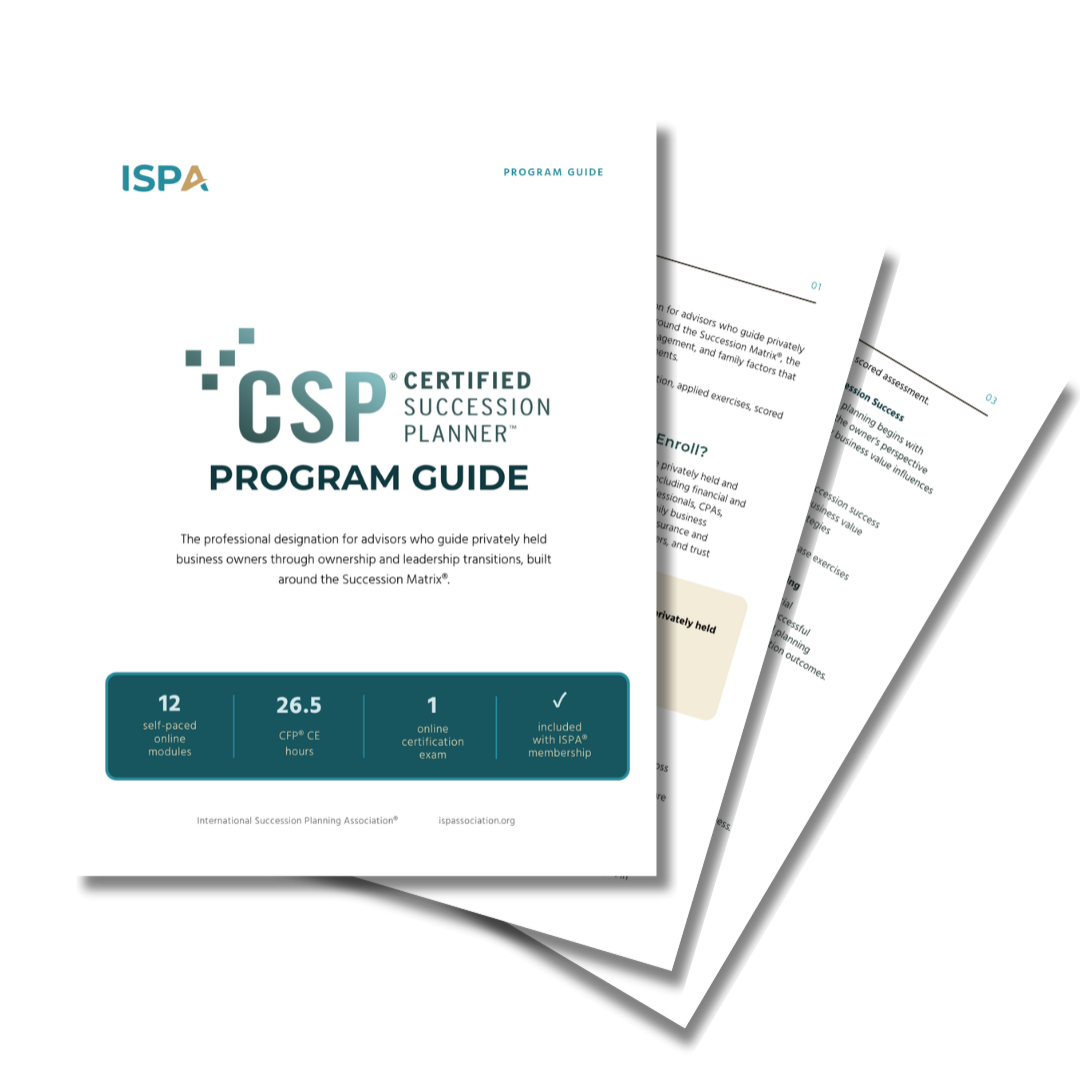
Download the CSP® Program Guide to review the 12-module curriculum, learning objectives, program format, estimated time commitment, 26.5 CFP® CE hours, certification exam, and ongoing designation requirements.
Coursework Overview & Learning Objectives
Want a Closer Look at the CSP® Program?
Download the CSP® Program Guide to review the 12-module curriculum, learning objectives, program format, estimated time commitment, 26.5 CFP® CE hours, certification exam, and ongoing designation requirements.
Coursework Overview & Learning Objectives
Intro 1: Defining Succession Success™
Succession is dependent upon success. Therefore, for succession to be an option, there must be a good foundation for business success to fulfill the dream of succession. However, a complication to identifying or achieving success is that we all define success differently. And adding to the complexity, there are six fundamental approaches to measuring business value. "Defining Succession Success™" discusses varying definitions of success, how they impact an owner's attitudes toward family, employees, and the community, and how they influence business planning and value.
Intro 2: How Succession Planning Builds Value
Succession planning is a business-growth strategy, not simply preparation for an eventual transition. By addressing the factors that support long-term continuity—including leadership, management, financial strength, strategic direction, and successor readiness—the succession planning process can strengthen business performance, reduce risk, and build sustainable value.
Module 1: Owner Motivation & Perspective
Owner Motivation and Perspective are the alpha and omega of succession planning. This foundational view influences every operational area, strictly determining the strategic direction, options, and opportunities for transition.
Module 2: Personal Financial Planning
Personal Financial Planning leverages business success to build independence. This accumulation enables owners to clear guarantees, initiate exit strategies, and confidently transfer control to the next generation of leadership.
Module 3: Business Structuring
Business structuring has a direct impact upon tax on profits, gifts, sales and, ultimately, cash flow to shareholders. These issues in turn impact financial security of owners, strategic planning resources, ownership agreements, and estate planning.
Module 4: Business Performance
Succession planning demands attention to business performance and therefore increases business value. Enhanced business performance benefits family members, employees, managers, and vendors.
Module 5: Strategic Planning
A foundational long-term initiative, the confirmation of a comprehensive succession strategy is a fundamental component of strategic planning. Strategic planning confirms operational strengths and weaknesses and evaluates resources relative to the achievement of priorities. A predictable priority of a business owner is the continuation of success, business succession.
Module 6: Leadership & Management Continuity
The identification, motivation and retention of highly qualified supporting managers and development of bench strength are essential to maintaining the viability of succession plans. Therefore, the development and constant regeneration of a management culture that can sustain and enhance historical success is imperative to succession.
Module 7: Management Synergy & Teamwork
Succession demands deep synergy across all stakeholders to navigate the Succession Matrix®. Yet, true teamwork is often elusive, as the competitive, ambitious personalities driving business success often struggle to prioritize collaboration over individual recognition.
Module 8: Successor Preparation
Moving the business to and through the next generation requires available, capable, competent and committed successors who will provide leadership through the transition.
Module 9: Family Dynamics
Family relationships can be an inherent advantage or disadvantage to succession planning. Effective interaction among the family members of current and/or prospective business owners is critical to achieving the unity and harmony needed to address complex business succession issues.
Module 10: Family Governance
“Families” come in all forms, shapes and sizes including in-laws, cousins, children, step children, business partners and employees. Establishing the forums and processes for optimal family communication regarding business and estate issues provides the foundation for a unified succession vision and builds a strong business that can be sustained through multiple generations.