Exit Planning vs. Succession Planning: Which Serves Clients Best?
 Succession Planning Resource
Understand the difference between exit planning and succession planning so you can guide clients with clarity.
Advisors often struggle to explain the difference between exit planning and succession planning. Clients use the terms interchangeably, which blurs expectations and leads to mismatched strategies. A clear distinction helps you uncover what the client really needs, and it also demonstrates the depth of advisory value you bring.
At the International Succession Planning Association® (ISPA®), these two approaches serve very different purposes. One prepares the owner for transition. The other prepares the business for continuity. Advisors who understand the difference can guide owners with far more clarity and confidence.
Quick Summary
Exit planning focuses on the owner’s financial readiness for transition. Succession planning focuses on ensuring the business continues through the next generation of owners, managers, and leaders. Advisors who pursue exit planning certification such as the CEPA® credential often complement it with Certified Succession Planner™ (CSP®) training, giving them both the financial lens and the holistic succession lens needed for long-term continuity.
Understanding the Difference Between Exit Planning and Succession Planning
Exit planning prepares the owner for their eventual departure from the business. Succession planning prepares the business to thrive long after the owner steps back.
Exit Planning: A Transaction With a Financial Focus
Exit planning is centered on the owner’s exit, emphasizing personal financial aspects such as:
- Understanding the impact of taxation
- Maximizing business valuation
- Structuring the sale or transfer
- Planning for the owner’s financial security
Exit planning is often transactional. The goal is to convert business value into liquidity and prepare the owner emotionally and financially for what comes next.
Succession Planning: A Holistic Approach to Business Continuity
At the ISPA, we define succession planning as ensuring the business continues through the next generation — not just transferring ownership to them. Getting the business “into the next generation’s hands” is relatively easy. Ensuring it successfully moves through them is where true advisory impact lies.
Succession planning requires that anything and everything that could disrupt continuity is addressed. This is why the Succession Matrix® is essential. It examines interconnected areas that determine long-term success, such as:
- Owner’s Motivations & Perspectives
- Successor Preparation
- Family Dynamics
- Family Governance
- Leadership Continuity
- Strategic Planning
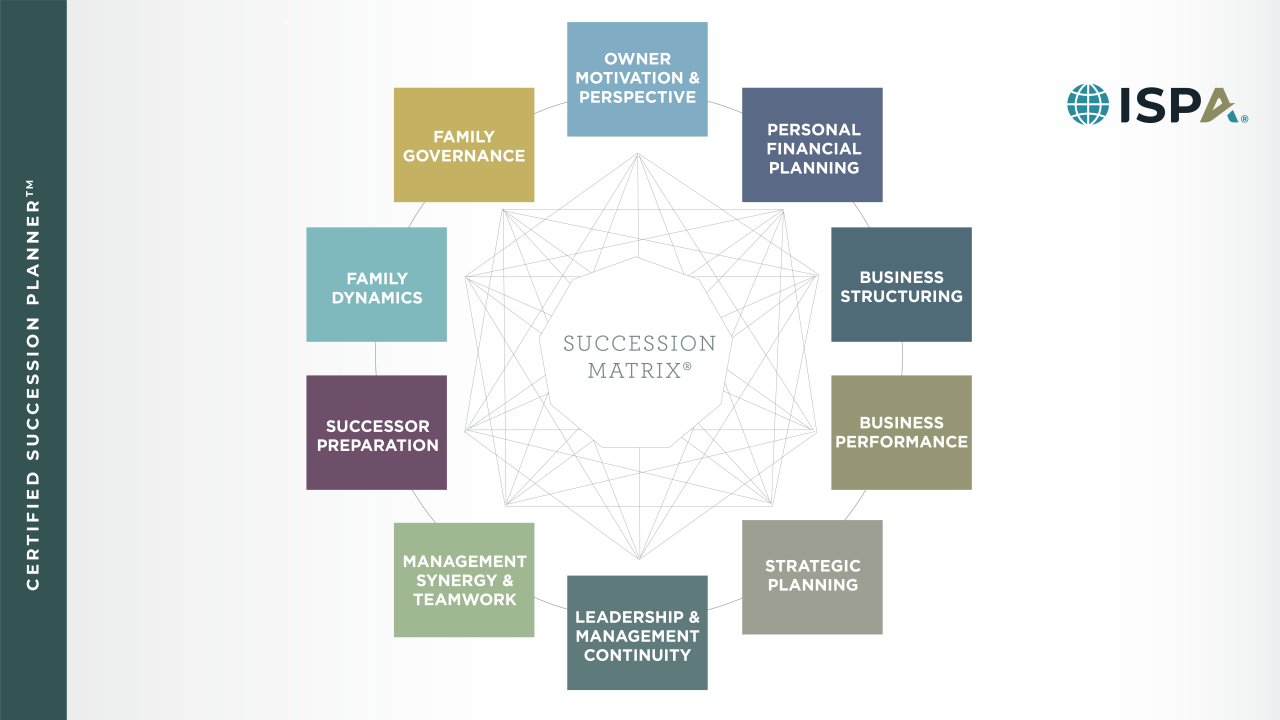
Each area influences the others. Challenges in one area create pressure in another. This interdependency is what makes succession planning complex, holistic, and relationship-driven.
For more information about the Succession Matrix®, read: The Succession Matrix: Key Components to Succession, According to Study.
What Advisors Solve With Each Approach
Both exit planning and succession planning are valuable — but they solve different problems.
Exit Planning Solves the Owner’s Transition Needs
Exit planning focuses on:
- What the owner wants
- When they want to transition
- How much they need from the business
- Tax impact and valuation strategy
Many exit planners help owners process the emotional reality of stepping away. But the work remains centered on the owner’s exit, not the organization’s ongoing success.
Succession Planning Solves the Business’s Long-Term Needs
Succession planning focuses on:
- Developing next-generation leaders
- Clarifying roles and expectations
- Navigating sensitive family dynamics
- Strengthening communication and governance
- Preserving culture during leadership shifts
Advisors using the Succession Matrix® can anticipate risks many owners overlook, such as:
- Long-term owners staying “in the saddle” too long
- Undefined successor authority
- Cultural disruption during leadership change
- Decision-making friction between generations
With succession planning, the advisor’s focus is continuity — not exit.
How Both Strengthen a Business Transition Strategy
A business transition requires both lenses.
Exit planning ensures the owner is financially ready. Succession planning ensures the business is structurally, culturally, and operationally ready.
When both are applied:
- Advisors can address the full scope of transition challenges
- Owners receive a more realistic and stable roadmap
- Successors gain clarity and development
This is why many advisors pair exit planning certification with CSP® training — financial insight alone does not create continuity.
A Simple Case Example Advisors Will Recognize
A business owner plans to exit within five years. They want clarity on valuation, taxes, proceeds, and what their life will look like post-transition. This is exit planning.
But the next-generation leader is not fully prepared. Culture is shifting. Managers are unclear on authority. Family members hold differing expectations. These are succession planning issues anchored in the Succession Matrix®.
If exit planning happens without succession planning:
- Culture erodes
- Leadership gaps widen
- Successor confidence weakens
- The business loses value
When advisors integrate both, clients experience smoother transitions, stronger teams, and more predictable outcomes.
Strengthen Your Advisory Practice
Advisors who want to deliver comprehensive transition guidance often develop expertise in both exit planning and succession planning. One cannot replace the other.
Exit planning strengthens your financial advisory skills. Succession planning strengthens your ability to guide leadership, culture, governance, and communication — all central to continuity.
Our team has supported advisors across industries as they strengthen both exit and succession capabilities, helping them guide owners and leadership teams with clarity and confidence.
Why Succession Planning Is the Future of Advisory Services
Learn why business transition advisory is rapidly becoming the must-have service for growth-oriented advisors in 6 Reasons Why Succession/Business Transition Planning Is the Future of Advisory Services.
Strengthening Your Advisory Skill Set
Enhance your practice with structured growth steps with the How to Grow as a Business Advisor Checklist.
Become an ISPA Member
Join a community of advisors focused on practical skills for continuity, leadership development, and succession support. The ISPA® membership gives you ongoing training, tools, and advisor resources.
As you deepen your expertise, strengthening both exit and succession skills allows you to confidently address the full difference between exit planning and succession planning in real-world advisory work.
Key Takeaways
- Exit planning focuses on the owner’s financial and personal transition.
- Succession planning ensures the business continues through the next generation.
- Succession planning requires a holistic, interpersonal, and strategic approach anchored in the Succession Matrix®.
- CEPA® and CSP® complement one another but solve different problems.
- Advisors who master both lenses deliver higher value and stronger outcomes.
- Understanding the difference between exit planning and succession planning enhances advisory impact.
FAQs About the Difference Between Exit and Succession Planning
What is the difference between exit planning and succession planning for advisors working with business owners?
Exit planning prepares the owner for their financial and personal transition. Succession planning prepares the business for leadership continuity, cultural stability, and long-term performance. Advisors often pursue both exit planning certification and CSP® training because each addresses different aspects of transition.
How do exit planning and succession planning relate during a business transition?
Exit planning supports the owner’s goals and timeline. Succession planning supports next-generation readiness and organizational stability. Strong transitions require both perspectives.
Which business transition strategy helps advisors prepare clients for both ownership and leadership changes?
A strategy that integrates business transition planning with leadership development, cultural alignment, and governance helps reduce uncertainty and strengthen continuity across generations.
Categories: : Matrix
Continue Learning
Signup for our newsletter, and follow us on social media for guidance, and updates focused on real-world succession planning.